
“PART 2
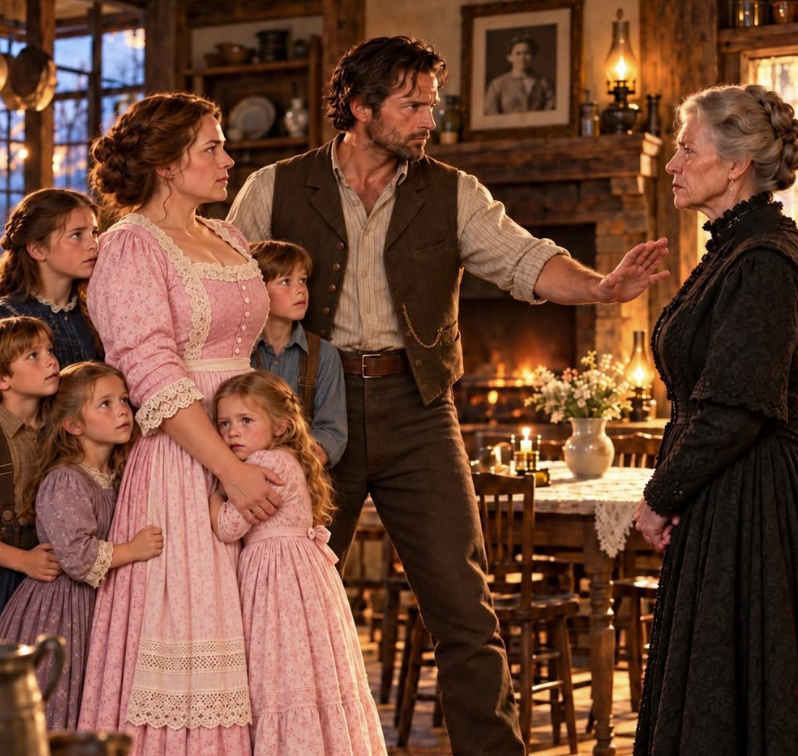
Gideon stepped fully into the kitchen, his gaze fixed on Agnes.
“Winnie isn’t replacing Eleanor,” he said.
“She’s doing what I should’ve done long ago—helping my children live again.”
Agnes stiffened.
“You think my daughter would want another woman wearing her apron?”
“I think Eleanor would want Maribel to be twelve instead of raising four children.”
Maribel’s breath caught.
Gideon’s voice broke.
“She’d want Tad to cry when he misses her.
She’d want Posy laughing.
And she’d want me to stop acting like I died with her.”
The room went painfully still.
Agnes looked toward the children, but Winifred saw the anger in her face collapse into grief.
“You don’t understand,” Agnes whispered.
“I understand more than you think.”
“No.” Agnes turned toward Winifred.
“She doesn’t belong here.”
Posy’s fingers tightened around Winnie’s skirt.
Then Maribel stepped forward.
“She does to us.”
Agnes recoiled as though struck.
Winifred immediately knelt beside Maribel.
“Sweetheart, loving me doesn’t mean choosing between us.
Your grandmother loves you too.”
Agnes stared at her.
For the first time, suspicion gave way to confusion.
“Why would you defend me?”
Winifred slowly stood.
“Because grief makes people afraid of losing what little they have left.”
Her voice trembled despite her effort to steady it.
“I know that fear.”
Gideon’s eyes narrowed.
“Winnie?”
She had hidden the truth for six years, believing silence made it easier to survive.
But five children were watching her now.
So was Agnes.
Winifred reached beneath her collar and drew out a tiny silver locket.
“My husband didn’t die alone, ” she whispered.
“Our daughter was with him.”
Gideon’s face changed.
“You had a child?”
“A little girl.
Clara.
She was five.”
Agnes went white.
The locket slipped from Winifred’s trembling fingers and struck the floor.
It opened.
Inside was a faded portrait of Clara.
Agnes stared at it, then suddenly gripped the table.
“No,” she whispered.
Winifred froze.
Agnes’s eyes filled with terror.
“I’ve seen that child before.”
“What?”
Agnes looked directly at Winifred.
“Because Eleanor had the same photograph.”

The floorboards groaned softly under the weight of the silence.
Outside, the cold Montana wind pushed against the glass, but inside the kitchen, not a soul dared to breathe.
Outside, the cold Montana wind pushed against the glass, but inside the kitchen, not a soul dared to breathe.
Winifred felt the blood drain from her face, leaving her ears buzzing like summer cicadas.
She dropped to her knees, her trembling fingers hovering over the open silver locket on the pine floor.
The tiny sepia image showed five-year-old Clara sitting on an apple crate, her hair curling in soft ringlets beneath an embroidered bonnet, clutching a wooden rabbit carved with one floppy ear.
She dropped to her knees, her trembling fingers hovering over the open silver locket on the pine floor.
The tiny sepia image showed five-year-old Clara sitting on an apple crate, her hair curling in soft ringlets beneath an embroidered bonnet, clutching a wooden rabbit carved with one floppy ear.
“What did you say?” Winifred’s voice was barely a thread of air.
Agnes Crowder did not answer immediately.
Her knuckles turned chalk-white against the edge of the kitchen table.
The haughty, rigid posture of the grieving grandmother completely gave way, replaced by a trembling, fragile shock that made her look every bit of her sixty-one years.
Her knuckles turned chalk-white against the edge of the kitchen table.
The haughty, rigid posture of the grieving grandmother completely gave way, replaced by a trembling, fragile shock that made her look every bit of her sixty-one years.
“Eleanor,” Agnes whispered, her gaze locked on the miniature face inside the locket.
“In her cedar trunk upstairs.
Wrapped in oilcloth with her childhood Bible and the silver christening spoon.
She kept it in the secret till at the bottom.”
“In her cedar trunk upstairs.
Wrapped in oilcloth with her childhood Bible and the silver christening spoon.
She kept it in the secret till at the bottom.”
Gideon took two swift, heavy strides across the kitchen.
He knelt beside Winifred, his broad hand steadying her shaking wrist as she picked up the silver pendant.
His dark eyes flicked from the locket to his former mother-in-law.
He knelt beside Winifred, his broad hand steadying her shaking wrist as she picked up the silver pendant.
His dark eyes flicked from the locket to his former mother-in-law.
“Agnes,” Gideon said, his deep voice thick with tension.
“What are you talking about? Eleanor never kept secrets from this family.
Where would she get a photograph of Winnie’s daughter?”
“What are you talking about? Eleanor never kept secrets from this family.
Where would she get a photograph of Winnie’s daughter?”
“Not of Winnie’s daughter,” Agnes gasped, tears finally breaching the dam of her wrinkled eyelids, spilling freely over her weathered cheeks.
“Of her niece.
”
“Of her niece.
”
The room seemed to tilt beneath Winifred’s knees.
“My niece?” Winifred repeated, bewildered.
“I was an only child.
My father was a cooper from Ohio, my mother died when I was sixteen.
I had no sisters.
No brothers.
No family left after Thomas and Clara were taken in the flood.”
“I was an only child.
My father was a cooper from Ohio, my mother died when I was sixteen.
I had no sisters.
No brothers.
No family left after Thomas and Clara were taken in the flood.”
Agnes sank heavily onto the wooden kitchen chair, her hands fluttering helplessly in her lap.
She looked at Maribel, then at Jonah and Pearl, who had clustered together near the cold cast-iron stove, their young eyes wide with confusion.
She looked at Maribel, then at Jonah and Pearl, who had clustered together near the cold cast-iron stove, their young eyes wide with confusion.
“You didn’t know,” Agnes murmured, her voice cracking under the weight of a thirty-year-old ghost.
“Lord have mercy on my stubborn soul.
You never knew.”
“Lord have mercy on my stubborn soul.
You never knew.”
She took a ragged breath and looked directly at Winifred.
“Before I married Mr. Crowder, I was a young woman in Ohio.
Foolish.
Reckless.
I had a child out of wedlock in the spring of 1848.
A girl.
My parents took her from my arms before she took her first breath, sent her to a foundling home three counties over, and married me off to an older farmer who brought me west to Montana.”
Foolish.
Reckless.
I had a child out of wedlock in the spring of 1848.
A girl.
My parents took her from my arms before she took her first breath, sent her to a foundling home three counties over, and married me off to an older farmer who brought me west to Montana.”
Winifred’s breath caught in her throat.
Her heart slammed against her ribs with terrifying force.
Her heart slammed against her ribs with terrifying force.
“Two years later,” Agnes continued, her voice breaking into quiet sobs, “I gave birth to Eleanor.
An honorable child.
A proper family.
But I never forgot my firstborn.
Never.
When Eleanor grew into a woman, I told her the truth about her half-sister.
I gave Eleanor the only thing I had kept—a receipt from the foundling hospital with the adoptive parents’ name.”
An honorable child.
A proper family.
But I never forgot my firstborn.
Never.
When Eleanor grew into a woman, I told her the truth about her half-sister.
I gave Eleanor the only thing I had kept—a receipt from the foundling hospital with the adoptive parents’ name.”
Agnes looked straight into Winifred’s widening eyes.
“The family who took my firstborn baby was named Shaw.
Samuel and Martha Shaw.”
Samuel and Martha Shaw.”
“My parents,” Winifred breathed,
her hand flying to her throat.
“My mother… she never told me.”
“My mother… she never told me.”
“She wouldn’t have,” Agnes wept softly.
“They loved you as their own.
But Eleanor… oh, my sweet Eleanor.
She spent five years writing letters to parishes across Ohio, trying to trace her sister.
She found where you had married Thomas Shaw.
She found where you had built a farm along the river.
And when you sent a birth notice to the county paper after your little girl was born, Eleanor hired an itinerant portrait-maker traveling through Ohio to secure a duplicate likeness of her niece.
She wanted to surprise you.
She wanted to show up on your doorstep, hold out her hands, and say, ‘I am your sister.’”
Tears poured down Winifred’s cheeks, burning against her chapped skin.
“Then why didn’t she? Why didn’t she ever come?”
“Then why didn’t she? Why didn’t she ever come?”
“The spring flood of seventy-six,” Gideon whispered,
the memory suddenly dawning in his eyes with terrible clarity.
“The Great Miami River broke its banks.
Whole towns were washed out.”
“The Great Miami River broke its banks.
Whole towns were washed out.”
He looked down at Winifred, his hand gripping her shoulder with an intensity that anchored her to the earth.
“Eleanor received a telegram,” Gideon said, his voice husky with raw grief.
“It listed Thomas Shaw, his wife, and their five-year-old daughter Clara among the casualties swept downstream.
The entire homestead was erased.
Eleanor wept for two weeks straight.
She took that little photograph, wrapped it in oilcloth, and laid it in her cedar chest, believing her sister’s bloodline had drowned in the mud.”
“I didn’t drown,” Winifred sobbed, burying her face in her apron.
“I was in town buying medicine for Clara’s fever.
When I came back, the bridge was gone.
The house was gone.
The barn was splintered matchsticks.
I spent three days digging through driftwood with my bare hands until I found them.”
“I was in town buying medicine for Clara’s fever.
When I came back, the bridge was gone.
The house was gone.
The barn was splintered matchsticks.
I spent three days digging through driftwood with my bare hands until I found them.”
She looked up, her vision blurred by an ocean of sorrow.
“I spent six years wandering from town to town, taking cleaning jobs, taking laundry, trying to find somewhere that didn’t echo with my baby’s laugh.
When I saw the advertisement for a ranch in Montana needing a woman to care for five motherless children, something in my chest pulled me here.
I thought it was just desperation.
I thought it was just the need to feel useful before I withered away.”
When I saw the advertisement for a ranch in Montana needing a woman to care for five motherless children, something in my chest pulled me here.
I thought it was just desperation.
I thought it was just the need to feel useful before I withered away.”
She turned to look at the five children.
Maribel stood frozen, a hand pressed against her trembling mouth.
Tad had crept forward, his little fingers brushing the hem of Winifred’s skirTS. Pearl was crying quietly into Jonah’s sleeve.
Tad had crept forward, his little fingers brushing the hem of Winifred’s skirTS. Pearl was crying quietly into Jonah’s sleeve.
“They aren’t strangers,
” Agnes whispered, bowing her silver head in total, agonizing shame.
“My God in heaven.
You aren’t replacing my daughter.
You’re her sister.
You’re their flesh and blood.”
“My God in heaven.
You aren’t replacing my daughter.
You’re her sister.
You’re their flesh and blood.”
For several minutes, the only sound was the ticking of the mantle clock and the muffled weeping of the two women.
Agnes slowly pushed herself up from the chair.
The rigid pride that had armored her against the world had completely dissolved.
She walked toward Winifred, her steps unsteady, and sank down onto the hard floorboards beside the younger woman.
The rigid pride that had armored her against the world had completely dissolved.
She walked toward Winifred, her steps unsteady, and sank down onto the hard floorboards beside the younger woman.
With trembling, aged hands, Agnes reached out.
She did not grab or demand; she merely cupped Winifred’s tear-stained cheek with the hesitant reverence of a mother touching a miracle.
She did not grab or demand; she merely cupped Winifred’s tear-stained cheek with the hesitant reverence of a mother touching a miracle.
“I looked at you,” Agnes cried, her voice tearing from her chest, “and I saw an enemy.
I saw someone trying to steal what was left of my Eleanor.
But you have her jawline.
You have her eyes.
When you sang over that washtub, it wasn’t a stranger’s tune—it was the song my mother sang in the Buckeye valley fifty years ago.
Can you ever forgive a bitter old fool who couldn’t see the light through her own darkness?”
Winifred looked into the aged, sorrow-carved face before her.
She saw the same stubborn chin that Maribel possessed.
She saw the same deep brown eyes that looked out from little Jonah’s face.
She saw the mother she had never known, grieving for the daughter she had never met.
She saw the same stubborn chin that Maribel possessed.
She saw the same deep brown eyes that looked out from little Jonah’s face.
She saw the mother she had never known, grieving for the daughter she had never met.
Winifred did not pull away.
Instead, she leaned into the frail palm, closed her eyes, and reached out to hold Agnes’s shaking hand against her cheek.
Instead, she leaned into the frail palm, closed her eyes, and reached out to hold Agnes’s shaking hand against her cheek.
“There is nothing to forgive, Grandmother,” Winifred whispered gently.
“Grief blinds the best of us.
But we don’t have to walk in the dark anymore.”
“Grief blinds the best of us.
But we don’t have to walk in the dark anymore.”
A collective breath seemed to rush out of the room.
Maribel was the first to move.
The twelve-year-old girl dropped to her knees beside Winifred, wrapping her arms around her neck and burying her face against Winifred’s collar.
“Aunt Winnie,” the girl sobbed, the heavy burden of two years of forced adulthood finally breaking apart into pure, cleansing childhood tears.
“You’re our Aunt Winnie.”
Then came Pearl and Tad, piling into their arms with fierce,
clinging hugs, followed by Jonah, who stood beside his father, trying to blink back tears before Gideon pulled the boy into his side with a strong, protective arm.
And little Posy, oblivious to the decades of hidden sorrow and tangled roots, simply clambered into Winifred’s lap, patted her wet cheek with a sticky hand, and declared with total, unshakeable certainty, “Winnie stays.”
Gideon looked down at the tangle of children,
the weeping grandmother, and the woman who had brought breath back into his suffocating house.
He didn’t speak, but when he extended his hand to help Agnes to her feet, his eyes met Winifred’s with a profound, unspoken devotion that made the kitchen feel warm for the first time in two bitter years.
Winter arrived in Montana with the roar of a ravenous beast, but inside the Marsh homestead, the frost never touched the glass.
The fallen ceiling in the back shed had been repaired before the first heavy snowfall, reinforced by Gideon and Jonah with sturdy cedar rafters.
In the cellar, the crates of apples, root vegetables, and cured hams were labeled neatly—half in Eleanor’s faded, elegant cursive, and half in Winifred’s round, practical hand, standing together side by side like sisters sharing a shelf.
In the cellar, the crates of apples, root vegetables, and cured hams were labeled neatly—half in Eleanor’s faded, elegant cursive, and half in Winifred’s round, practical hand, standing together side by side like sisters sharing a shelf.
Above the stone fireplace in the parlor,
the picture frame that had sat facedown for nearly two years was finally turned right side up.
It was a beautiful daguerreotype of Eleanor Marsh, smiling in the Montana sunshine, holding a newborn Jonah.
And right beside it, framed in polished walnut that Gideon had carved with his own hands during the long winter evenings, sat the silver locket containing little Clara.
And right beside it, framed in polished walnut that Gideon had carved with his own hands during the long winter evenings, sat the silver locket containing little Clara.
The dead were no longer hidden away like painful wounds; they were honored like foundation stones.
Every Tuesday, Agnes Crowder arrived in her small buggy, wrapped in wool blankeTS. She no longer wore only black.
A soft mauve shawl rested over her shoulders, knitted by Winifred during the quiet evenings by the hearth.
A soft mauve shawl rested over her shoulders, knitted by Winifred during the quiet evenings by the hearth.
The sharp-tongued matriarch spent her afternoons sitting in the rocking chair, teaching Maribel how to mend fine linens, listening to Jonah recite his history lessons, and peeling sweet dried apples for Tad and Posy.
Whenever her eyes met Winifred’s across the kitchen, there was no hostility—only a deep, peaceful understanding between two women who had walked through the valley of the shadow of death and found each other on the other side.
Whenever her eyes met Winifred’s across the kitchen, there was no hostility—only a deep, peaceful understanding between two women who had walked through the valley of the shadow of death and found each other on the other side.
Maribel flourished.
With an aunt to shoulder the cooking, the laundry, and the quiet worries of running a household, the twelve-year-old girl finally returned to school in town.
Her laughter returned, ringing through the frosty yard as she built snow forts with her brothers, her cheeks flushed with the vibrant color of youth.
And Gideon Marsh became a different man.
He no longer dragged his boots across the threshold like a condemned prisoner coming home to a cell.
He came inside before dusk, shedding his snowy sheepskin coat with an eager smile, sitting at the head of a table where six tin plates were set—and every single one of them was filled with warm food, hearty bread, and shared stories.
He came inside before dusk, shedding his snowy sheepskin coat with an eager smile, sitting at the head of a table where six tin plates were set—and every single one of them was filled with warm food, hearty bread, and shared stories.
When the children were tucked into their beds beneath thick patchwork quilts, Gideon would sit by the hearth with his pipe, watching Winifred mend stockings by the light of the kerosene lamp.
They spoke of small things: the price of hay, the coming spring thaw, the way Posy had mastered her alphabet.
But beneath the ordinary words ran a river of deep, quiet companionship that grew stronger with every turn of the season.
But beneath the ordinary words ran a river of deep, quiet companionship that grew stronger with every turn of the season.
In late April, the great thaw finally came.
The snowdrifts receded up into the timberline, leaving the prairie grass green, vibrant, and bursting with yellow buttercups.
The mountain streams sang as they rushed down toward the Missouri, carrying the last traces of winter away.
The mountain streams sang as they rushed down toward the Missouri, carrying the last traces of winter away.
On a warm Saturday afternoon, the farmhouse was filled with the rich scent of roasting beef and wild plum pies.
Neighbors from three valleys over had tied their wagons to the split-rail fences, their boots kicking up dry dust as fiddles began to tune up on the front porch.
Neighbors from three valleys over had tied their wagons to the split-rail fences, their boots kicking up dry dust as fiddles began to tune up on the front porch.
The yard was spotless.
The front porch had been painted a crisp, cheerful white, and smoke rose peacefully from both chimneys into the bright blue Montana sky.
The front porch had been painted a crisp, cheerful white, and smoke rose peacefully from both chimneys into the bright blue Montana sky.
In the master bedroom upstairs, Winifred stood before the oval dressing mirror.
She wore a simple, elegant dress of cream-colored linen, adorned with delicate lace collars that had once belonged to her sister Eleanor.
Her hair was pinned neatly behind her ears, her cheeks glowing with health, her eyes clear and unshadowed.
Her hair was pinned neatly behind her ears, her cheeks glowing with health, her eyes clear and unshadowed.
The door swung open, and Agnes stepped inside, carrying a small bouquet of wild blue lupines and sweetgrass tied with a silk ribbon.
The old woman stopped, her eyes glistening with soft, joyful tears.
“You look lovely, Winifred,” Agnes said, her voice rich with grandmotherly pride.
“More lovely than words can tell.
”
“More lovely than words can tell.
”
“Thank you, Grandmother,” Winnie answered softly, turning to face her.
“I was afraid… wearing Eleanor’s lace.”
“I was afraid… wearing Eleanor’s lace.”
Agnes walked over, taking Winnie’s hands into hers, pressing the wild flowers into her palms.
“Eleanor loved Gideon with all her soul,” Agnes whispered gently.
“And she loved those five babies more than life itself.
Do you think she would want them to live in cold silence? No, child.
In heaven, my Eleanor is singing today, because the sister she searched for has become the guardian of everything she left behind.”
“And she loved those five babies more than life itself.
Do you think she would want them to live in cold silence? No, child.
In heaven, my Eleanor is singing today, because the sister she searched for has become the guardian of everything she left behind.”
Agnes leaned in, kissing Winnie’s cheek, then smoothed the lace collar with loving, withered fingers.
“Go down there, Winnie.
Your family is waiting.”
Your family is waiting.”
Winifred walked down the stairs.
At the landing, five children stood waiting, dressed in their Sunday best.
Jonah stood tall in a new wool vest,
his hair combed flat.
Tad grinned, missing two front teeth, clutching a small carved wooden rabbit that had once belonged to Clara—a gift Winnie had given him on Christmas morning.
Pearl stood beside Maribel, both girls wearing bright blue ribbons in their dark curls.
Tad grinned, missing two front teeth, clutching a small carved wooden rabbit that had once belonged to Clara—a gift Winnie had given him on Christmas morning.
Pearl stood beside Maribel, both girls wearing bright blue ribbons in their dark curls.
And little Posy, now four years old and growing fast, stepped forward, holding out a single buttercup with a gap-toothed, radiant smile.
“Pretty Winnie,” Posy beamed.
“Thank you, my darling,” Winnie whispered, blinking back happy tears as she kissed the little girl’s forehead.
Maribel stepped up, linking her arm gently through Winifred’s.
The shadows had completely disappeared from the young girl’s eyes; she stood tall, lighthearted, and whole.
The shadows had completely disappeared from the young girl’s eyes; she stood tall, lighthearted, and whole.
“Are you ready, Aunt Winnie?” Maribel asked softly.
“I am,” Winifred replied, squeezing her hand tight.
They stepped out onto the sun-drenched porch together.
Beneath the great cottonwood tree in the front yard, the valley minister stood with his open Bible.
Surrounding him were dozens of neighbors who had watched the Marsh ranch transform from a house of hollow misery into a home of abundance and grace.
Surrounding him were dozens of neighbors who had watched the Marsh ranch transform from a house of hollow misery into a home of abundance and grace.
And standing before the minister, his dark hair gleaming in the spring sun, his weathered face softened by an expression of pure,
unreserved devotion, was Gideon Marsh.
He wore a dark broadcloth suit, his shoulders straight, his eyes locked onto Winifred as she walked down the porch steps.
The lines of grief that had once aged him ten years had been erased by hope, replaced by a radiant, steadfast love that needed no apologies.
The lines of grief that had once aged him ten years had been erased by hope, replaced by a radiant, steadfast love that needed no apologies.
When Winifred reached the shade of the cottonwood, Gideon stepped forward and took both of her hands into his large,
calloused palms.
His grip was warm, solid, and unshakable.
His grip was warm, solid, and unshakable.
“Winifred Shaw,” Gideon said, his deep voice carrying clearly across the quiet yard, filled with an honesty that resonated in every heart present.
“You came to this ranch when we were starving for more than bread.
You gave my children their childhood back.
You taught an old fool how to live again.
You didn’t come to replace what we lost—you came to show us that love doesn’t end with a grave.
It grows.
It expands.
And it brings us home.”
“You came to this ranch when we were starving for more than bread.
You gave my children their childhood back.
You taught an old fool how to live again.
You didn’t come to replace what we lost—you came to show us that love doesn’t end with a grave.
It grows.
It expands.
And it brings us home.”
He looked into her hazel eyes, his thumbs gently brushing the backs of her hands.
“I promise to honor your past, to protect your heart, and to spend every day of my life making sure you never feel alone again.”
Tears of pure, overwhelming gratitude welled in Winifred’s eyes, but she did not hide them.
She looked at the five smiling children standing beside them, at Agnes smiling through tears under the porch eaves, and then back into the steady, faithful eyes of the man before her.
She looked at the five smiling children standing beside them, at Agnes smiling through tears under the porch eaves, and then back into the steady, faithful eyes of the man before her.
“I came here looking for work, Gideon,” Winifred whispered, her voice clear and ringing with absolute peace.
“And God gave me a family.
I take you, your children, and this land with my whole soul, until the end of my days.”
“And God gave me a family.
I take you, your children, and this land with my whole soul, until the end of my days.”
The minister spoke the ancient, sacred words, and when Gideon leaned down to kiss her,
a great cheer erupted from the neighbors.
The fiddles struck up a lively reel, children’s laughter filled the warm mountain air, and Tad sprinted across the green grass with Jonah hot on his heels.
The fiddles struck up a lively reel, children’s laughter filled the warm mountain air, and Tad sprinted across the green grass with Jonah hot on his heels.
As Gideon held Winifred close against his chest, her head resting securely against his heartbeat, she looked up toward the clear Montana sky.
A gentle spring breeze rustled the cottonwood leaves above them,
carrying the sweet scent of blooming lilacs and wild clover.
For the first time in six long years, the hollow ache in Winifred’s chest was gone—filled to overflowing by the laughter of five children, the blessing of an old mother, and the enduring warmth of a love that had turned sorrow into gold.
For the first time in six long years, the hollow ache in Winifred’s chest was gone—filled to overflowing by the laughter of five children, the blessing of an old mother, and the enduring warmth of a love that had turned sorrow into gold.