
Chapter 1
Chapter 1
THE ACTUARIAL SCIENCE OF BETRAYAL
A Memoir of Fraudulent Mortgages, Emergency Passports, and the Exact Price of a Kyoto Abandonment
Chapter 1: The Inciting Audacity & The Cream Stationery
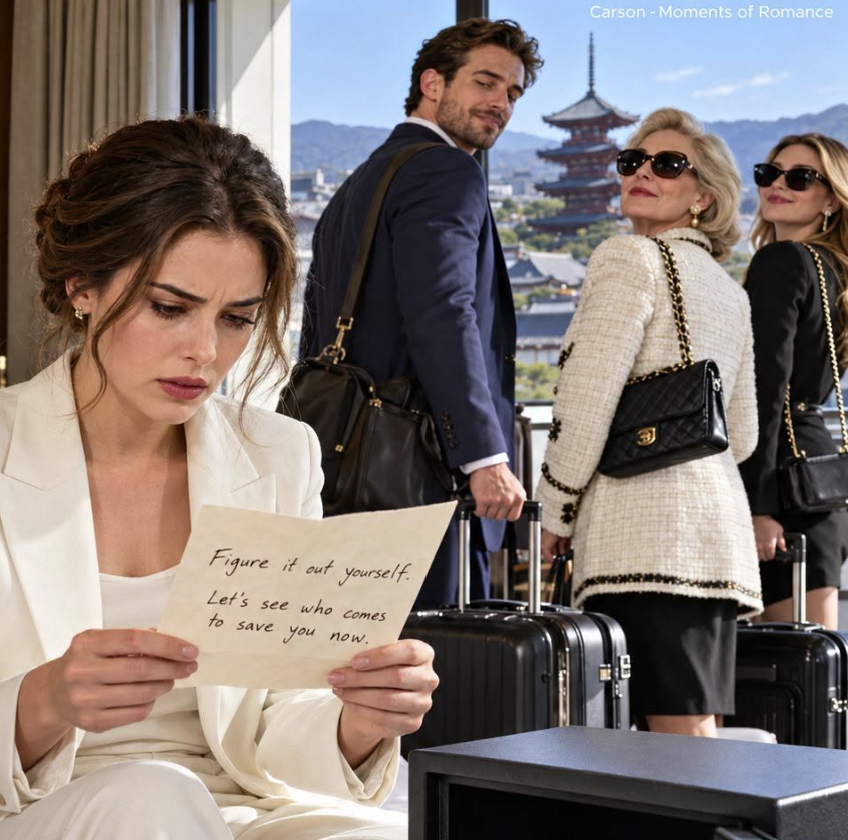
The note was lying on the pillow beside mine, folded exactly once with the sharp, deliberate crease of someone who believed they were executing a masterpiece of psychological warfare. It was written on cream stationery harvested from the hotel’s front desk, and it featured a fascinating collaboration of two distinct handwritings. The first belonged to my husband, Ethan. His block letters were unmistakable, a penmanship born of a man who still mentally sounded out large words. It read: Figure it out yourself. Underneath, etched in his mother Margaret’s sharp, slanted cursive—a handwriting that looked suspiciously like a seismograph recording a minor earthquake—were the words: Let’s see who comes to save you now.
It was 9:40 on a Thursday morning in Kyoto, Japan. Outside the window, the ancient city hummed with the orderly, polite rhythm of a society built on mutual respect and structural discipline. Inside Room 812, I was looking at a crime scene devoid of chalk outlines but practically radiating petty malice. The room safe, embedded in the mahogany wardrobe, stood wide open with its metallic jaw unhinged. My passport was gone. So was my phone. Ethan’s matching navy-blue suitcase was gone. Margaret’s aggressively compartmentalized pill organizer, which she treated with the reverence of the Ark of the Covenant, was gone. Even his sister Julia’s high-wattage travel hair dryer had vanished from the bathroom counter. They had meticulously scoured the room, executing a surgical extraction of anything that could provide mobility, communication, or basic human comfort. Everything was gone, save for my clothes, my purse, and the paper cup of green tea I had made at two o’clock in the morning when the jet lag had first set in.
I sat on the edge of the mattress for perhaps a minute. I did not scream. I did not throw the hotel’s tastefully muted decorative pillows against the wall. I simply stared at the empty safe, and then my hands became completely, terrifyingly still. That was a physiological response I had learned and perfected during my nineteen years working as a travel insurance claims adjuster. In my profession, human catastrophe is not a tragedy; it is a spreadsheet. When an itinerary collapses, when an artery bursts over international waters, or when a heavily indebted family attempts a coordinated abandonment in a foreign hemisphere, panic is merely the theft of usable time. You do not cry over the structural failure of a bridge while you are still standing on it. You assess what is missing, you inventory what remains, and you calculate the immediate sequence of actions required to prevent a total systemic collapse.