
Chapter 4
Arthur changed that.
The first time I met him, he knelt beside me in a social worker's office.
He didn't ask for a hug.
He didn't promise a perfect life.
He simply placed a small wooden bird on the table.
“I made this,” he said. “It isn't very good, but it's yours if you want it.”
I picked it up.
One wing was slightly larger than the other.
“Why?”
“Because I thought you might like something that belongs only to you.”
I still had that bird.
It traveled with me through college, officer training, and every permanent assignment.
Diane signed the adoption papers, too.
She attended the ceremonies and smiled for photographs.
But her affection rarely survived the departure of an audience.
Arthur called me his daughter.
Diane called me the child Arthur had insisted on adopting.
That distinction followed me throughout childhood.
When Chloe wanted horseback riding lessons, Diane arranged them immediately.
When I wanted to join a science camp, she asked whether Arthur understood the expense.
When Chloe wrecked her first car, Diane blamed the weather.
When I earned a B+ in chemistry, Diane questioned whether my academic expectations were realistic.
I learned to work harder.
I learned to need less.
Most importantly, I learned which parent would be waiting when I came home.
Arthur attended every school ceremony he could.
He helped me study calculus.
He taught me how to change a tire and read a construction contract.
When I earned my Army commission, he stood so proudly that strangers congratulated him.
Diane attended the ceremony because photographers were present.
She left before the family reception.
I told myself it didn't matter.
Arthur was enough.
For years, he was.
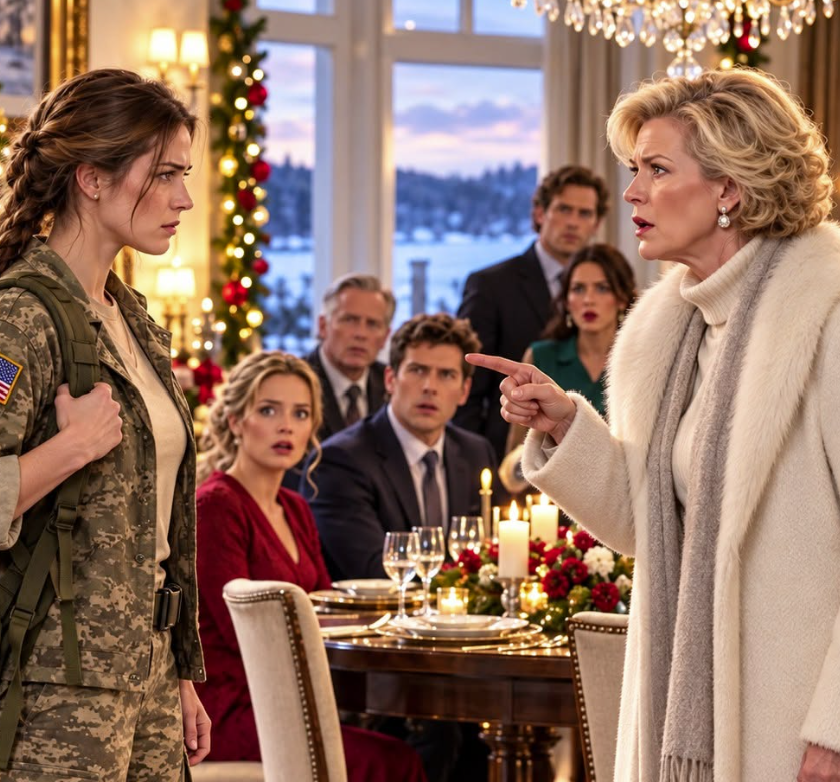
“Are you going to stand there all evening?”
Diane's voice brought me back to the dining room.
I looked toward her.
She was standing beside an empty space near the far wall.
“There's another chair in the breakfast room,” she said. “Someone can bring it in.”
One of the servers looked uncomfortable.
A woman named Maria approached quietly.
I recognized her immediately.
She had worked for Arthur and Diane for nearly twelve years.
“Captain Elena,” she whispered. “Welcome home.”
Her smile was genuine.
“It's good to see you, Maria.”
She squeezed my forearm.
“Your father would have been very happy.”
I swallowed.
“Thank you.”
Diane cleared her throat.
“Maria, the chair?”
“Yes, Mrs. Whitmore.”
Maria disappeared toward the kitchen.