
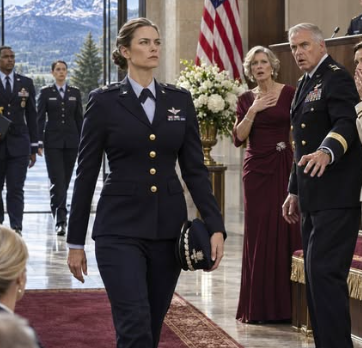
Chapter 43
She did not make herself smaller to make room for me.
She simply corrected what she had repeated and recognized what she had once failed to ask.
When she finished, the applause was warm and unforced.
Tessa stepped down from the lectern, and I met her in the aisle.
“You did well,” I told her.
She gave a breathless little smile.
“I’m glad I said it.”
“I’m glad you chose your own words.”
She looked toward the audience, then back at me.
“I want to be clear that my service is still mine.”
“It is.”
“And so is yours.”
“Yes,” I said. “It is.”
She offered her hand, then changed her mind and opened her arms.
I hugged her.
It was not the easy embrace of people who had never been hurt.
It was the careful, honest embrace of two people who had stopped asking each other to carry their father’s story.
Our father did not attend the event.
He had sent Tessa a brief note wishing her well, with no request that she change what she planned to say.
She showed it to me afterward.
The note was careful, but not controlling.
That mattered, though it did not erase anything.
A few days later, he asked whether I would meet him at the garden behind his home.
I considered the request for a full afternoon before answering.
I chose a place outside the house, where the old photographs and familiar rooms would not decide the shape of the conversation for us.
The garden was quiet when I arrived.
Late autumn sunlight rested on the stone path, and the last leaves clung to the branches above the bench.
My father was already there, without his dress uniform.
He stood when he saw me, then seemed uncertain whether to offer a hand.
I decided before I reached him.
“Thank you for coming,” he said.
“I came to listen.”
He nodded, accepting the boundary without asking me to make it softer.
For a moment, we looked at the garden rather than each other.
Then he said, “I am sorry.”
The words were plain.
He did not add that he had been protecting the family.
He did not add that the office had been complicated or that he had meant well.
“I let an explanation stand that I had no right to treat as your decision,” he continued. “When I learned the application had not reached the board, I should have corrected the record. I did not. I let you believe the board had considered you and passed you over.”