
Chapter 2
When the drink touched her dress, Vanessa stared at Rachel as though something unforgivable had happened.
“This was custom made.”
“I’m sorry,” Rachel said immediately. “I can bring you a cloth.”
Vanessa looked at her sleeve.
Then at Rachel.
Then at the crowd gathering around them.
“You people are supposed to be trained.”
Rachel’s jaw tightened.
She said nothing.
Grant had been standing nearby.
Instead of ending the embarrassment, he seemed amused by it.
He glanced toward the glass display case near the far wall.
Inside sat the violin that had belonged to his grandmother.
Grant walked over.
“Maybe we should give everyone something more entertaining to remember.”
Rachel’s stomach dropped.
The display case opened.
Grant removed the instrument.
Vanessa’s irritation turned into a smile.
“Yes,” she said. “Let Rachel entertain us.”
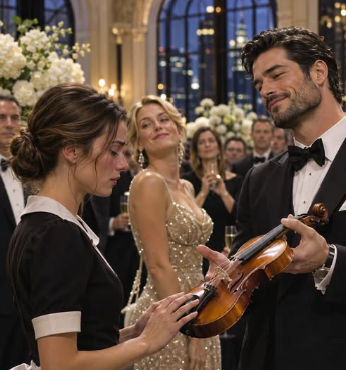
That was how Rachel ended up standing beneath a chandelier while nearly two hundred strangers waited for her to make a fool of herself.
Grant lifted the violin.
“My grandmother loved this instrument,” he announced. “Nobody has played it in years.”
His guests leaned closer.
Rachel stared at it.
Grant noticed.
“You recognize a violin, at least?”
“I know what it is.”
Something in her voice made him hesitate.
Only briefly.
Then his smile returned.
“Well, that puts you ahead of me.”
Several guests chuckled.
Rachel looked toward the kitchen doors.
Ruth’s expression was no longer worried.
She looked almost expectant.
Grant stepped closer.
“You’ve been working in this house for four years, Rachel. You’re quiet. You never complain. You barely speak unless someone speaks to you first.”
“That’s my job.”
“No,” he said. “Your job is cleaning rooms and carrying trays.”
The laughter came again.
Rachel’s fingers tightened around the edge of the tray.
Grant lifted the violin between them.
“But tonight you keep staring at this thing like it belongs to you.”
Rachel finally looked directly at him.
That stopped his smile.
Not because she looked angry.
Because she didn’t.
She looked heartbroken.
Grant should have ended it there.
Years later, he would admit that.
But the version of Grant Whitmore standing in that ballroom had spent most of his adult life believing every uncomfortable moment could be turned into a joke.
He had inherited money young.
He had inherited a large property business after that.
People laughed when he wanted them to laugh.
They agreed when he wanted agreement.
Very few people ever told him no.