
Chapter 2
“It means,” I said, “you didn’t buy an engine five years ago, Ms. Matthews. You rented a driver and leased a locomotive.”
“We paid you forty-two thousand dollars a month, Peterson,” she said, her voice dropping into that cold, defensive register people use when they realize they’ve walked into a corner they painted themselves. “For sixty months. That is over two and a half million dollars. You are claiming that after two and a half million dollars, this company owns nothing?”
“You own every single byte of production history, every CAD file, every work order, and every scrap of scrap-rate data your lines produced,” I replied evenly. “You own every sensor, every servo, every server rack, and every foot of fiber-optic cable in this building and the three satellite facilities in Ohio and Indiana. George Whitman bought top-tier hardware. I made sure of it.”
“Then give us the credentials,” she said, straightening her spine, trying to recover the authority that had slipped away three minutes into the hour. “Hand over the root keys, the source repositories, and the system diagrams. If the hardware belongs to us, our internal team will run it.”
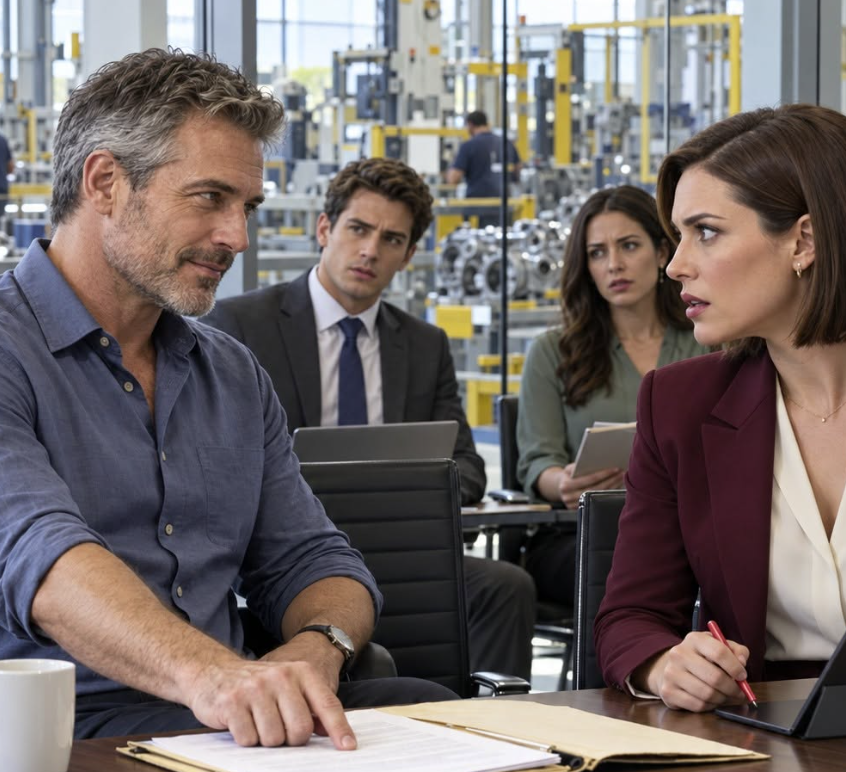
Beside her, Marcus didn’t look confident. He was staring at the second page of Section Seven, his jaw working slowly.
“You don't understand,” I said. “The hardware belongs to you. The software that tells the hardware how to talk to each other belongs to me. It doesn’t reside on your local storage arrays. It never has.”
Olivia frowned, looking at Marcus. “What is he talking about? Our pre-acquisition audit said we had an integrated manufacturing execution system running across eighteen production bays.”
“You do,” Marcus said, his voice barely above a whisper. “Through an API bridge. A cloud-tethered dynamic runtime.”
“A bridge to what?”
“To my servers,” I answered. “Housed in a private co-location center in Columbus, managed by my company. Every thirty milliseconds, your stamping presses, your robotic welders, your paint booths, and your automated guided vehicles check in with that runtime. It reconciles tool wear, recalculates cycle timing based on steel gauge variations, and dynamically balances power draws so you don't trip the substation breakers when three lines hit peak load simultaneously.”
I glanced at the clock on the wall. It was 9:14 AM.
“Your HR packet,” I continued, nodding toward the unopened envelope resting against my cold coffee, “specifies that my termination is effective immediately upon conclusion of this meeting. It states my enterprise access was revoked at nine o'clock this morning.”