
Chapter 2
The study fell so quiet that the hiss of the wood embers in the hearth sounded like rushing water.
Outside, the Wyoming wind swept across the eaves, scattering loose snow against the windowpanes with a dry, scratching rattle.
Eliza felt the air thin out of her lungs. Her fingers curled instinctively into the soft calico of her skirt, pressing over the swell that had remained her private torment for four agonizing months.
“My mother?” Her voice was barely audible above the draft. “My mother never set foot in Wyoming. She lived and died in a Pennsylvania mill town, sewing shirts for twelve cents a dozen.”
Samuel Whitaker shook his head slowly. He removed his spectacles, cleaned the fogged glass with a silk handkerchief, and set them back on his nose with deliberate, lawyerly precision.
“She worked in Pennsylvania after the summer of 1865, Mrs. Hart,” Whitaker said gently. “Before that, her name was Clara Vance. And in the spring of sixty-four, she was a schoolteacher in the territorial outpost that eventually became this valley.”
Jackson didn't speak. He stepped back toward the desk, his gray eyes fixed on the heavy parchment deed Whitaker had unrolled. The cattle baron’s knuckles were still red and split from wrestling the freezing calf the night before, but the tremor in his hands had nothing to do with the winter cold.
“Silas Thorne never owned this valley alone,” Whitaker continued, pointing a gloved finger to the faded iron-gall ink at the bottom of the territory patent. “The original charter for the valley basin—eighteen thousand acres of bottomland, grazing rights, and the perennial water easement of Willow Creek—was granted jointly to two partners. Silas Thorne and Clara Vance.”
Jackson’s jaw tightened into granite. “My father told me he bought the schoolhouse plot from an estate after the war. He told me he secured the water rights fair and square through the territorial land office.”
“Silas Thorne bought many things, Mr. Thorne,” Whitaker replied with a heavy sigh. “Honesty was rarely among them.”
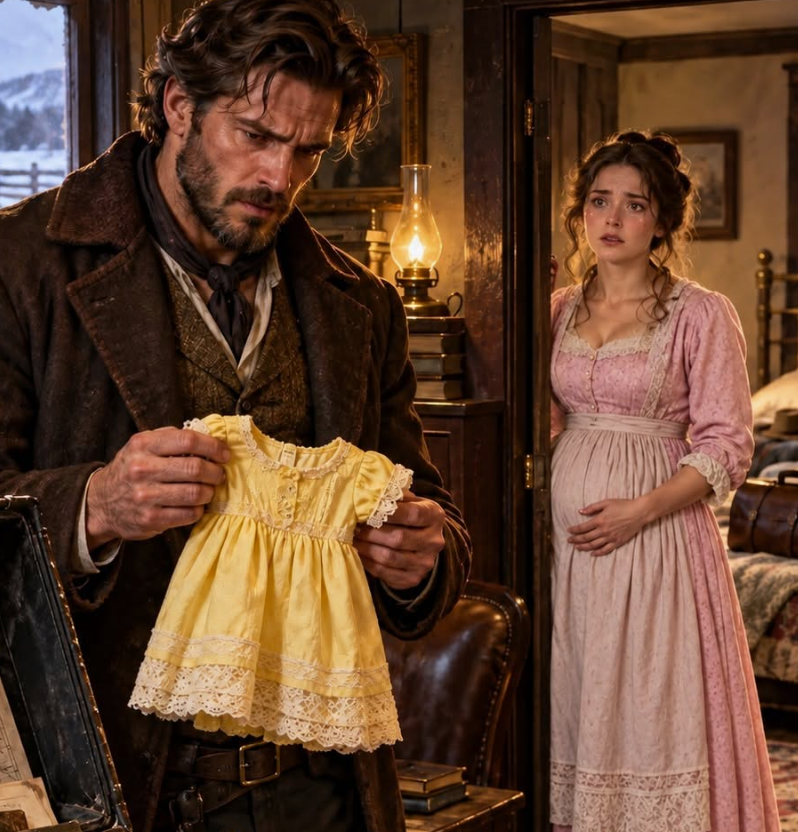
The attorney turned toward the black trunk still yawning open beneath the frost-rimmed study window. The pile of wool blankets had been tossed aside; the delicate yellow bonnet and booties lay resting on the scarred floorboards where Jackson had dropped them.
“Your father was an ambitious man, Jackson,” Whitaker said, his voice dropping into a somber, measured cadence. “In the summer of sixty-five, when the railroad survey arrived and land values skyrocketed overnight, Silas realized the land partnership was worth fifty times its purchase price. But Clara Vance held fifty percent of the voting shares and the sole legal title to the water rights. She intended to deed half the valley to the newly arriving homesteaders—free of cost—to build a township.”
Whitaker looked directly at Eliza, his eyes full of solemn sympathy.
“Silas could not permit that. He altered the partnership registry. He leveraged forged debt notes through an unscrupulous judge in Cheyenne, claiming Clara’s father had defaulted on mining supplies. When Clara went to challenge the lien, Silas threatened to have her younger brother imprisoned for horse theft on fabricated charges. Clara had no money to fight a protracted territorial suit. She fled east on the midnight stage, penniless, terrified, and broken. She changed her surname to Hart, took a job in the textile mills of Pittsburgh, and raised her daughter in deliberate obscurity.”
Eliza’s knees gave way.
Before her skirt could touch the floor, Jackson’s strong arms were around her. He caught her against his broad chest, lifting her effortlessly, his rough coat smelling of cedar smoke, pine resin, and snow. He carried her across the room and set her gently into the deep leather armchair behind his desk.
“Easy,” Jackson murmured, his voice husky, thick with an anguish that tore through his usual stoicism. “Breathe, Eliza. Just breathe.”
He knelt on the floor beside the chair, never letting go of her trembling right hand. For the first time, he didn't care that his attorney was watching. He didn't care about propriety, or ledgers, or the cattle freezing in the northern draws. He pressed her hand against his stubbled cheek, his eyes glistening with unshed tears.
“My father ruined her,” Jackson whispered, the realization striking him like an axe into green timber. “My father stole everything your family had, and built this empire on her bones. And I sat here for twelve years... proud of Thorne Ranch.”
“He did not build an empire, Mr. Thorne,” Whitaker interrupted quietly. “He built a debt on stolen ground. And in the final days of his life, when the doctors told him his heart would not see another sunrise, the fear of eternal judgment finally broke through his pride.”
Whitaker reached down, tapped the yellowed envelope lying on the green blotter, and pushed it across the mahogany grain until it rested against Eliza’s fingers.
“Silas summoned me to his bedside three days before he died,” Whitaker said. “He drew up a secret codicil to his will. A conditional conveyance. He gave me strict, legally binding instructions, backed by a trust fund placed in a Boston repository.”
The attorney’s voice rang with absolute finality.
“The codicil decreed that the moment Jackson Thorne faced financial ruin—the moment the Thorne bloodline was forced to liquidate the stolen land—the title to Thorne Ranch would not go to the banks. It would revert entirely, unconditionally, to the lawful heir of Clara Vance.”
Whitaker bowed his head slightly toward Eliza.
“The bank notices you’ve been receiving these past four months, Jackson? The foreclosure threats? The loan recalls?”
Jackson looked up, his brow furrowed in utter bewilderment. “The bank in Omaha has been demanding forty-two thousand dollars by the first of December. They refused to extend my paper by a single week.”
“The bank in Omaha did not recall your loans,” Whitaker revealed, a faint, wry smile touching his mouth. “The Boston trust bought your debt notes three weeks ago. I personally orchestrated the pressure, Jackson. Your father’s will stipulated that I could only intervene when you had exhausted every personal resource—when you had opened this trunk to retrieve the original parcel maps to sell your heritage.”
Whitaker gestured toward the trunk.
“Silas knew you would never open this trunk until you had reached the absolute end of your pride. He hid the original partnership deed in the false bottom beneath those blankets. And he knew that the day you opened it, I would receive notification from the territorial clerk that the survey records were being pulled.”
Eliza stared at the letter on the desk. Across the heavy parchment, in shaky, ancient script, were the words:
FOR ELIZA HART'S CHILD.
With shaking fingers, Eliza broke the black wax seal.
Inside was a single folded sheet of vellum, written in the crabbed, deteriorating hand of Silas Thorne, dated October 1876:
To whoever carries the blood of Clara Vance,I was a thief. I told myself I was building a future for my son, but a man cannot build a righteous house on stolen timber. I took your mother's rightful land and drove her into the cold.If you are reading this, my son has failed to hold what I stole. The land is returning to where it belonged from the beginning.Take Thorne Ranch. Take every steer, every acre, every dollar in the cattle accounts. It is yours by divine and territorial law. But if my boy Jackson is anything like his mother—if there is any mercy left in the heart of Clara Vance’s child—do not cast him out into the snow as I cast your mother out.May the Almighty forgive the greed of Silas Thorne.
The letter slipped from Eliza's fingers, fluttering onto her lap.
The room seemed to tilt on its axis.
Four hours ago, Eliza had been an impoverished cook, terrified of being driven from the house with a scandalous secret, saving pennies in an old leather boot so her unborn baby wouldn't starve in a boarding house.
Now, she was the sole, undisputed owner of eighteen thousand acres of the richest cattle country in Wyoming Territory.
Thorne Ranch did not belong to Jackson.
It belonged to her.
And the man she loved—the proud, silent cattle baron who commanded fifty men with a single glance—was legally a trespasser in his own home.
Jackson slowly rose to his feet.
The broad, powerful shoulders that had carried the weight of the ranch for a decade seemed to bow beneath an unbearable burden. He looked at the deed. He looked at the letter. Then he looked at the tiny yellow dress resting on the floor beside the trunk.
The color had completely drained from his face, leaving behind only the stark, desolate acceptance of a man whose world had collapsed into ashes.
“It’s yours,” Jackson said, his voice flat, hollowed out by grief. “All of it. The land. The house. The cattle.”
He stepped back toward the doorway, his boots heavy against the floorboards.
“Jackson…” Eliza pleaded, reaching out.
“You don't have to leave, Eliza,” he said, not looking at her eyes, his gaze fixed on the timber floor. “You don't have to hide in the night. You don't have to sew baby clothes out of scraps while you count pennies for a stage ticket. You own the valley. You can hire the best ranch manager in the territory. You can raise our child in safety, in comfort, with a name that no one will ever dare drag through the mud.”
He reached for the latch of the study door.
“Where are you going?” she cried out, struggling to stand.
Jackson stopped, his hand resting on the brass handle. He didn't turn around.
“A man who lives on stolen ground is a squatter,” Jackson said, his voice cracking with an agony so deep it cut through Eliza like a winter wind. “And a man whose father ruined your mother has no right to ask you for anything. I'll have the foreman saddle my gelding. I have two hundred dollars of my own in my saddlebag. I’ll take a train out of Laramie tonight. You will never have to see my face again.”
“Jackson Thorne, you stop right there!”
The command was so fierce, so ringing with absolute authority, that both Jackson and Samuel Whitaker froze in place.
Eliza pushed herself up from the leather armchair. She didn't wobble. She didn't hesitate. The exhaustion and fear that had haunted her for four months seemed to burn away in a sudden furnace of fierce, unyielding resolve.
She walked across the room, her loose calico dress rustling, until she stood directly between Jackson and the door.
She reached down, scooped up the tiny yellow baby dress from the floor, and pressed it hard against his broad, muscular chest.
“You think this land is why I stayed?” she demanded, her dark eyes flashing with tears of pure fury and love. “You think eighteen thousand acres of frozen dirt matters to me?”
Jackson stared down at her, his lips parting in stunned silence.
“When I came to this house four months ago, I was half-dead from loneliness,” Eliza said, her voice trembling with raw, unfiltered emotion. “I watched you work until your hands bled. I watched you ride out into thirty-below blizzards to save a single dying calf that wasn't worth twenty dollars at the stockyards. I saw the way you treated every man on your payroll like a brother. I fell in love with you, Jackson. Not your name. Not your cattle. And certainly not your father’s sins.”
She grabbed his right hand, lifting it up and pressing his large, calloused palm firmly against the swell of her belly.
Beneath his fingers, right through the coarse linen of her apron, a tiny, unmistakable movement fluttered—a gentle, rhythmic kick.
Jackson’s breath caught in his throat. His entire body shuddered as though he had been struck by lightning.
“That is your child, Jackson,” Eliza whispered, her voice softening into a plea that made the timber walls feel like a sanctuary. “Our baby doesn't need eighteen thousand acres. Our baby needs a father who knows what honor is. And I don't want a ranch manager. I want the man who sat by the fire with me in July and told me he was lonely.”
Tears finally breached the iron walls of Jackson Thorne’s composure.
They spilled over his rugged, sun-browned cheeks, glistening against his dark stubble. He sank down to both knees right there in front of the study door, wrapping his powerful arms around Eliza’s waist, burying his face against her stomach, weeping with the shuddering, cleansing grief of a man who had finally been delivered from a lifelong exile.
“Eliza…” he choked out, his voice muffled by the folds of her dress. “I love you. God help me, I have loved you since the night the lightning struck Willow Creek. I was too terrified to say it. Too proud. Too afraid that a broke, bitter cowboy had nothing to offer a woman like you.”
Eliza buried her fingers in his thick, dark hair, pressing him close against her heart, letting her own tears fall freely onto his shoulders.
“You offered me warmth, Jackson,” she murmured softly. “You offered me a home. That’s all I ever wanted.”
From across the room, Samuel Whitaker quietly cleared his throat.
The attorney reached into his leather case, pulled out a fresh, unblemished sheet of territorial parchment, dipped a steel nib into Jackson’s inkwell, and began writing with swift, deliberate strokes.
“Mr. Thorne. Mrs. Hart,” Whitaker announced without looking up from his drafting. “Under the laws of Wyoming Territory, a sole titleholder of an undivided land grant may execute a joint tenant indenture upon the solemnization of marriage, creating an irrevocable tenancy by the entirety. Furthermore, the Boston trust funds held in Clara Vance’s name—totaling sixty-four thousand dollars in accrued mining dividends—will be disbursed upon said union to liquidate every existing operational debt of Thorne Ranch.”
Whitaker looked up over his spectacles, a wide, triumphant grin crinkling the corners of his eyes.
“Reverend Campbell is currently snowbound at the stagecoach inn just three miles down the valley road. The snowplow cleared the track twenty minutes ago. If my horse can make it through the drifts, I can have him here by four o’clock this afternoon.”
Jackson slowly looked up, his eyes shining with a brilliance Eliza had never seen before.
He didn't rise from his knees. Instead, he took Eliza’s right hand into both of his, his touch astonishingly gentle.
“Eliza Hart,” Jackson said, his deep voice ringing through the quiet house with eternal, unshakable devotion. “Will you stay? Will you marry an ignorant cowboy who needs you to teach him how to live? Will you be my wife, and the mistress of this valley, and the mother of my child?”
Eliza looked down into the honest, weathered face of the man who held her whole world in his hands.
She smiled—a radiant, tearful smile that seemed to banish every shadow of winter from the room.
“I was never going to leave, Jackson,” she whispered, leaning down to press her forehead against his. “As long as you wanted me.”
Spring came to Wyoming with an explosion of vibrant life.
The great snowdrifts melted from the high ridges, swelling Willow Creek until its crystal waters rushed singing through the lush green pastures of the valley basin. Thousands of white-faced cattle grazed peacefully across the rolling meadows, fat and healthy on the rich spring grama grass.
The debt notices from Omaha were gone, burned to white ash in the great stone fireplace. The northern acreage remained untouched, its boundaries secure under the newly ratified deed that hung framed in polished walnut above the study desk: The Thorne-Vance Cattle Company.
At the edge of the ranch yard, near the banks of the creek where Clara Vance had once walked twenty-four years earlier, a new timber building gleamed in the morning sunshine—the Clara Vance Memorial Schoolhouse, funded entirely by the Boston trust, where thirty children from neighboring homesteads now gathered every morning to learn their lessons.
On the front porch of the main house, a gentle May breeze rustled the calico curtains.
Eliza sat in the wide cedar rocking chair, dressed in a fresh linen gown trimmed with yellow ribbon. In her arms, sleeping peacefully against her chest, was a healthy, round-cheeked baby girl with dark curls and deep, curious gray eyes.
The baby was wearing a tiny, perfectly stitched yellow wool dress, trimmed with lace that caught the golden afternoon light.
The sound of galloping hooves echoed across the yard.
A moment later, Jackson rode up to the hitching rail on his tall bay gelding. He swung down from the saddle with the easy, powerful grace of a man who owned the ground beneath his boots—not by force, but by love and stewardship.
He pulled off his Stetson, wiped the trail dust from his brow, and took the porch steps two at a time.
The hard, haunted lines that had once carved his face had vanished, replaced by an easy, radiant smile that appeared the instant his eyes found his wife and daughter.
He tossed his hat onto the wicker bench, knelt beside the rocking chair, and leaned in to press a tender kiss against Eliza’s lips.
“Afternoon, Mrs. Thorne,” he whispered.
“Afternoon, Mr. Thorne,” Eliza smiled, leaning into his touch. “How are the yearlings on the north range?”
“Fat and stubborn,” Jackson laughed softly. He turned his gaze down to the bundle in her arms, his large, scarred finger gently stroking the baby’s petal-soft cheek. Little Clara gave a tiny, contented sigh in her sleep, her miniature fist curling tightly around her father’s knuckle.
Jackson’s chest rose and fell with a profound, unmeasured gratitude.
He reached into his vest pocket, pulled out a small, polished gold locket on a delicate chain, and opened it. Inside, opposite the picture of Eliza’s mother, was a lock of dark baby hair.
He draped it gently around Eliza’s neck, letting the pendant rest against her collarbone.
“I was looking at the ledgers in town today,” Jackson murmured, his gray eyes locking onto hers with absolute, eternal devotion. “The banker told me Thorne Ranch is worth more than any spread in the territory.”
Eliza arched a brow, smiling gently. “Is it?”
Jackson leaned down, kissing the crown of his daughter’s head, then rested his forehead softly against Eliza’s cheek, breathing in the scent of lavender and sunshine.
“The banker doesn't know what he's talking about,” Jackson whispered against her skin. “Every acre in Wyoming isn't worth the yellow thread in this dress. My whole fortune is sitting right here on this porch.”
Eliza reached up, resting her hand over his heart, feeling the steady, powerful beat that anchored her world.
And as the sun sank behind the snow-capped peaks of the Laramie Range, painting the Wyoming sky in brilliant shades of amber, rose, and gold, the great house on Willow Creek was finally filled with the one thing Silas Thorne could never steal:
Peace, laughter, and an unshakeable love that had turned an old wrong into an everlasting home.
← PREV
NEXT →
Table of Contents