
Chapter 5
I remembered Dad photographing my learner's permit two years earlier for the car insurance and Marissa using the family computer to print my college forms.
"Probably," I admitted.
"Please preserve everything you've received, and don't discuss the details with anyone you believe may be involved."
When I hung up, I found my chemistry teacher standing beside the charging station.
"Lena," she said, "the counselor's office is asking for you."
I thought the bank had called the school.
Instead, I walked into the front office and saw my father talking to Diane Fischer, the district's homeless-student liaison and one of our school social workers.
Dad wore his nicest work jacket and the face he used when he wanted strangers to think he was a patient man carrying a terrible burden.
"There she is," he said, loud enough for the receptionist to hear. "Thank God."
I stopped in the doorway.
"I've been worried sick," he continued. "She's been stealing from us, staying out all night, and refusing to come home."
Diane didn't move from her chair.
"Mr. Whitaker, I need to speak with Lena alone."
Dad gave a tired little laugh.
"She'll lie to you. I think she's using something, and I don't want the school enabling it."
I felt the blood leave my face.
He wasn't content with putting me on the street; he wanted the adults I trusted to stop believing me.
"Would you wait outside?" Diane asked him.
"I'm her father."
"And she's eighteen," Diane replied. "I need a private conversation."
He left, but not before giving me a look that promised I'd pay for embarrassing him.
Diane waited until the door closed.
"Are you safe where you're staying?"
For nine days, people had asked whether I was tired, whether I'd finished my homework, and whether I wanted to order a prom ticket.
Nobody had asked me that.
I opened my mouth to say yes and started crying instead.
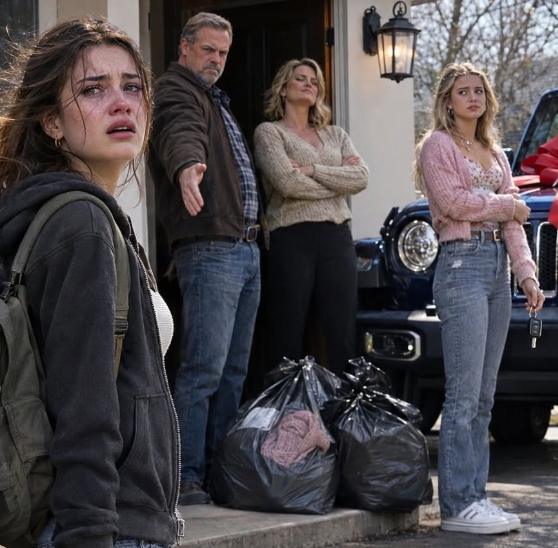
I told her about the garbage bags, the lost money, and the nights in the car.
I showed her the banking screenshots, the Jeep photograph, and the loan application, because somehow it felt easier to present evidence than to say my father didn't want me.
Diane listened without interrupting.
Then she said, "You're not going back to that parking lot tonight."
She explained that students without a fixed, regular, adequate place to sleep could qualify for protections under the McKinney-Vento program, even if they were keeping their grades up and pretending everything was fine.